| MOQ: | 1000 square meters |
| Price: | Negotiate |
| Standard Packaging: | Drums |
| Delivery Period: | 15-30 days, depending on order requirements |
| Supply Capacity: | 30000 square meter per month |
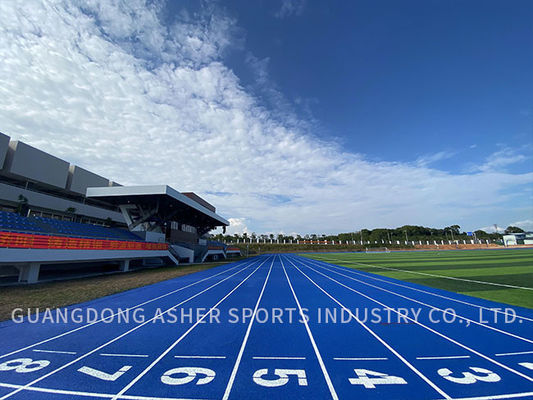
A school oval, training ground and community exercise area do not need the same layout. This customizable full polyurethane running-track surface lets the venue brief guide the layer selection, color zones and markings instead of forcing every project into one standard presentation.
A continuous site-applied finish is useful where the track has bends, starts or adjoining activity spaces. Its purchase value comes from fitting those spaces while keeping the specified running construction consistent.

Full-PU construction uses polyurethane-based layers installed on the prepared base. The elastic construction and textured wearing finish are selected together, allowing the buyer to compare the complete build rather than isolated buckets of material.
The sample view helps explain the difference between the running face and the body beneath it. Final depth, component selection and required performance are stated in the project specification; a sample alone does not establish every test result.

Choose colors for running lanes, event areas or recreation zones with a clear purpose. Contrasting linework helps separate activities, while an approved layout prevents last-minute changes to lane positions or boundary details.
Physical color samples are preferable to a screen-only decision. Where new work joins an existing track, assess the older surface's weathered shade and establish an acceptable transition before ordering.

The agreed thickness belongs to the whole running-track system, not an arbitrary extra layer added to cover a defective foundation. Examine base soundness, local repairs, moisture conditions and drainage before surfacing begins.
An outdoor full-PU track needs the designed falls and outlets to handle water at the venue. Keep the selected primer, elastic materials and wearing finish within a compatible construction, and follow the application sequence supplied for it.
A continuous finish avoids individual tile edges in the running area, but it still needs sensible care. Remove abrasive debris, use compatible cleaning methods and check high-traffic zones and equipment crossings.
Local defects should be assessed before they enlarge. Compatible patching or a later wearing-surface renewal may be possible where the underlying construction remains sound; the repair route depends on the actual condition.

For a new venue, use the final drawing to calculate material quantities and line-marking work. For a staged renovation, identify which sections are retained and how new edges meet them.
Retain the selected colors, material references and installation records so future work starts from known information. USAWEGI serves the group's sports-surfacing range; manufacturing origin and shipment terms follow the actual offer, not the location of the sales contact.
Can colors and lane markings be changed? They can be discussed with the layout and selected material range. Agree the physical color references and line plan before production and site work.
Does low maintenance mean no resurfacing will ever be needed? No. Wear and exposure still change the surface, and later repairs or renewal should follow an assessment of the installed layers and base.
Send the site plan, area, activity mix, preferred colors and whether the job is new construction or renovation. Include photographs where existing edges or older materials must be retained.
We can put the selected full-PU build, supply quantities and installation responsibilities into one proposal. Compare alternative track systems in our system-selection article if you are still deciding between full-PU, sandwich and porous construction.
|
|
| MOQ: | 1000 square meters |
| Price: | Negotiate |
| Standard Packaging: | Drums |
| Delivery Period: | 15-30 days, depending on order requirements |
| Supply Capacity: | 30000 square meter per month |
A school oval, training ground and community exercise area do not need the same layout. This customizable full polyurethane running-track surface lets the venue brief guide the layer selection, color zones and markings instead of forcing every project into one standard presentation.
A continuous site-applied finish is useful where the track has bends, starts or adjoining activity spaces. Its purchase value comes from fitting those spaces while keeping the specified running construction consistent.

Full-PU construction uses polyurethane-based layers installed on the prepared base. The elastic construction and textured wearing finish are selected together, allowing the buyer to compare the complete build rather than isolated buckets of material.
The sample view helps explain the difference between the running face and the body beneath it. Final depth, component selection and required performance are stated in the project specification; a sample alone does not establish every test result.

Choose colors for running lanes, event areas or recreation zones with a clear purpose. Contrasting linework helps separate activities, while an approved layout prevents last-minute changes to lane positions or boundary details.
Physical color samples are preferable to a screen-only decision. Where new work joins an existing track, assess the older surface's weathered shade and establish an acceptable transition before ordering.

The agreed thickness belongs to the whole running-track system, not an arbitrary extra layer added to cover a defective foundation. Examine base soundness, local repairs, moisture conditions and drainage before surfacing begins.
An outdoor full-PU track needs the designed falls and outlets to handle water at the venue. Keep the selected primer, elastic materials and wearing finish within a compatible construction, and follow the application sequence supplied for it.
A continuous finish avoids individual tile edges in the running area, but it still needs sensible care. Remove abrasive debris, use compatible cleaning methods and check high-traffic zones and equipment crossings.
Local defects should be assessed before they enlarge. Compatible patching or a later wearing-surface renewal may be possible where the underlying construction remains sound; the repair route depends on the actual condition.

For a new venue, use the final drawing to calculate material quantities and line-marking work. For a staged renovation, identify which sections are retained and how new edges meet them.
Retain the selected colors, material references and installation records so future work starts from known information. USAWEGI serves the group's sports-surfacing range; manufacturing origin and shipment terms follow the actual offer, not the location of the sales contact.
Can colors and lane markings be changed? They can be discussed with the layout and selected material range. Agree the physical color references and line plan before production and site work.
Does low maintenance mean no resurfacing will ever be needed? No. Wear and exposure still change the surface, and later repairs or renewal should follow an assessment of the installed layers and base.
Send the site plan, area, activity mix, preferred colors and whether the job is new construction or renovation. Include photographs where existing edges or older materials must be retained.
We can put the selected full-PU build, supply quantities and installation responsibilities into one proposal. Compare alternative track systems in our system-selection article if you are still deciding between full-PU, sandwich and porous construction.